رئيس مجلس الإدارة
سعيد اسماعيل
رئيس التحرير
مروة أبو زاهر

رئيس مجلس الإدارة
سعيد اسماعيل

رئيس التحرير
مروة أبو زاهر

The Main Banking Services Available to the public at Branches of the Central Bank of Egypt

Central Bank of Egypt Launches Annual Women Financial Inclusion Event

As part of the Central Bank of Egypt’s (CBE) commitment to increasing women’s financial inclusion rates and encouraging their use of formal financial services, the CBE launched the “Women Financial Inclusion Event”, which annually kicks off on the 8th of March, coinciding with International Women’s Day and continues till the end of the month.

The CBE revealed that the “Women Financial Inclusion Event”, launched in 2019, has contributed to availing nearly 1.4 million financial products to women by March 2024. This includes the opening of 664,000 bank accounts and 196,000 e-wallets, as well as issuing 530,000 prepaid cards.

The event comes in line with the CBE’s efforts to promote women’s financial inclusion, yielding tangible progress in the financial inclusion rate of women, which reached 68.8% by the end of December 2024, reflecting a 295% growth rate compared to 2016.

As a result, around 23.3 million women, out of a total of 33.9 million women aged 15 and above, currently have access to financial services and own transaction accounts.

This progress was driven by the Central Bank of Egypt’s Financial Inclusion Strategy 2022-2025, aimed at promoting financial inclusion across all segments of society, with women at the forefront.

The Strategy is founded on several pillars, including the development of women-supportive legal and regulatory environment, the launch of stimulating initiatives and projects in collaboration with ministries, relevant authorities, and international institutions, as well as guiding banks to offer financial products that meet women’s needs.

Additionally, it emphasizes the importance of spreading financial literacy – a key pillar of the Financial Inclusion Strategy -, as it plays a critical role in raising financial awareness and enabling women to make sound financial decisions.

Several regulations have been issued to foster supportive legislative and regulatory environment to facilitate women’s access to banking services and products. Notably, these regulations include guidelines for financial inclusion products and services that simplify due diligence procedures for individuals and economic activities.

This allows customers, particularly women, to open accounts using only their National IDs for personal or business purposes, without requiring any additional documents.

This initiative aims to assist housewives, micro-entrepreneurs, and craftspeople, while also enabling women to open accounts for their minor children, addressing barriers that women encounter when engaging with the banking sector, especially divorced or widowed mothers.

Within its ongoing efforts to promote women’s economic empowerment and provide suitable financial services and products, the Central Bank of Egypt has trained bank employees in customer segmentation and retail products departments, in collaboration with international organizations (such as the OECD and Women’s World Banking)

, as this training aimed to encourage them to thoroughly assess women’s financial needs. As a result, banks are already issuing and developing tailored financial packages for women within the banking sector that cater to their specific requirements.

In light of Fintech’s role in boosting women’s financial inclusion and facilitating their access to financial services, especially in remote areas, the CBE has sponsored the Digital Saving and Lending Groups Project “Tahwisha.”

This project aims to incentivize women in Egypt’s rural areas and countryside to motivate them to save, and apply for loans to open small and micro-enterprises. As of December 2024, the number of women participating in Tahwisha’s electronic application reached approximately 246,400.

Furthermore, around 209,000 women within savings groups and 102,500 women outside these groups have benefited from financial literacy and awareness campaigns.

As part of promoting digital transformation and integrating women into the formal financial sector, the Central Bank of Egypt launched the “Digitization of International Remittances Project” for Egyptians working abroad.

The project aims to provide banking products to remittance recipients, around 1.5 million of whom are women, representing about 85% of total beneficiaries.

The CBE also participates in the Women’s Economic and Social Empowerment Program (WESEP), which is implemented in collaboration with the United States Agency for International Development (USAID) and executed by “Pathfinder”.

Central Bank of Egypt to Learn from its Pioneering Cybersecurity Experience in the Financial and Banking Sectors

Central Bank of Egypt to Learn from its Pioneering Cybersecurity Experience in the Financial and Banking Sectors

In light of Egypt’s commitment to strengthening cooperation with African states, the Central Bank of Egypt (CBE) hosted a specialized technical team in the field of cybersecurity from Bank of Tanzania (BoT). The visit aimed at offering insights into the Egyptian pioneering cybersecurity experience in the financial and banking sectors, especially Egypt’s Financial Computing Incident Response Team (EG-FinCIRT), which stands as a pioneering and distinguished model in the field of cybersecurity across Africa and the Middle East.


Central Bank of Egypt

During their 3-day visit, the Tanzanian team responsible for Financial Sector Computer Emergency Response Center (TZ-FinCERT) received a comprehensive overview of EG-FinCIRT’s activities and services, along with the incident response mechanisms implemented for managing cyber threats. The visit aimed to benefit from the Egyptian experience to build and enhance technical capacities of the TZ-FinCERT, in addition to empowering collaboration between both parties in the field of cybersecurity.


Dr. Sherif Hazem, the CBE’s Sub-Governor for Cybersecurity Sector, emphasized, “The visits of specialized cybersecurity delegations from foreign central banks, particularly from African countries, reflect the prominent position the CBE has attained in this field. This standing is manifested in the establishment and operation of the region’s first sectorial CERT, in alignment to the evolving global threats facing digital infrastructure”.


Dr. Ibrahim Mostafa, Assistant Sub-Governor of the CBE and Director of EG-FinCIRT, highlighted, “The exchange of expertise and the fostering of cooperation among response teams from various central banks have become a critical priority in light of the significant advancements in Cyber-attacks, and the expansion in the use of digital financial technology. We are keen to enhance coordination and cooperation with Incident Response Teams around the world, especially African, Arab and Islamic countries”.


Notably, the Tanzanian delegation’s visit is part of an ongoing series of visits from African countries to strengthen cooperation and exchange expertise with the CBE in the field of cybersecurity. During the visit, Tanzanian delegation was briefed on Egypt’s steadfast efforts to enhance cybersecurity at CBE and across the banking sector. This includes the issuance and circulation of Egypt’s first edition “Financial Cybersecurity Framework,” as well as assessing the readiness of banks and financial institutions operating within the sector to manage cybersecurity. Additionally, they gained insights into the inspection, auditing, and approval processes of all digital solutions and FinTech applications before issuing the required licenses and accreditations to operate in the Egyptian market.

Central Bank of Egypt Hosts a Delegation from the Central Bank of West African States to Share Egypt’s Experience in Establishing the New Banknote Printing House in the New Administrative Capital 

Central Bank of Egypt Hosts a Delegation from the Central Bank of West African States to Share Egypt’s Experience in Establishing the New Banknote Printing House in the New Administrative Capital 

In line with Egypt commitment to strengthening relations and fostering cooperation with African nations across various sectors, the Central Bank of Egypt (CBE) hosted a delegation from the Central Bank of West African States (BCEAO) to gain insights into the establishment of the new Egyptian Banknote Printing House, which is recognized as one of the most advanced printing facilities in the Middle East and Africa.

Central Bank of Egypt


The visit comes as part of the BCEAO’s efforts to capitalize on Egypt’s experience, with the aim of establishing its own national printing house. During the visit, the delegation conducted an in-depth tour in the New Administrative Capital’s Printing House, exploring all stages of banknote production, from the design phase to the final delivery of the banknote at the (Cash Center). Additionally, they learned about the facility’s production capacity, which enables it to meet the needs of Egypt and other countries in the region.


The delegation also explored the advanced technologies employed by the Printing House in its production processes, alongside the high levels of security systems designed to safeguard printed banknotes against forgery and counterfeiting.


They were further briefed on the quality control measures implemented to maintain accuracy and quality of production, including the comprehensive banknotes testing protocols implemented at every stage of production prior to issuance. Moreover, the visit emphasized the pivotal role of the ongoing Research and Development System (R&D) that drives improvements in product quality, production efficiency, and seamless currency circulation.

Notably, this marks the BCEAO’s second visit to the facility in less than two years. During the previous visit, they  by Egypt  toured the Printing House during their participation in the African Currency Forum, hosted by

in 2023. The delegation gained valuable insights from the visit, recognizing the new Printing House as a world-class banknote printing hub, which features the latest and most advanced global technologies.

Central Bank of Egypt Hosts a Delegation from the Bank of Tanzania

In light of Egypt’s commitment to enhance cooperation with African nations and deepen bilateral relations across various sectors, the Central Bank of Egypt (CBE) recently hosted a high-level delegation from the Bank of Tanzania (BOT), headed by its Deputy Governor.

The visit comes within the framework of the joint cooperation program between the two central banks, aimed at fostering knowledge exchange in the fields of digital transformation, FinTech, and payment systems.

Mr. Rami Aboulnaga, Deputy Governor of the Central Bank of Egypt received and welcomed the Tanzanian delegation, reaffirming the CBE’s commitment to strengthen regional collaboration with African nations, by sharing Egypt’s pioneering experience in digital banking services, in light of the technological advancements that have significantly facilitated financial transactions for citizens.

During their visit, the Tanzanian delegation was briefed on CBE’s efforts to align with the global developments in digital transformation, including FinTech, electronic payments, cybersecurity, and data science.

Additionally, they gained insights on the CBE’s strategic formulation and execution of key regulatory frameworks, corporate governance, corporate policies, and human resources management.

This visit underscores the strong and historic ties between the Central Bank of Egypt and African central banks, particularly the BOT, which reinforces the ongoing efforts to bolster regional cooperation, and promote the exchange of expertise and knowledge.

MPC decides to keep key policy rates unchanged

MPC decides to keep key policy rates unchanged

 In today’s meeting, the Monetary Policy Committee (MPC) of the Central Bank of Egypt (CBE) decided to maintain the CBE’s overnight deposit rate, overnight lending rate, and the rate of the main operation at 27.25 percent, 28.25 percent, and 27.75 percent, respectively. The Committee also decided to maintain the discount rate at 27.75 percent.  

While the outlook for global economic growth and inflation remains uncertain, some central banks in both advanced and emerging market economies have continued to gradually cut their policy rates. Others have opted to remain cautious in light of unfolding global economic developments.


Economic growth remains broadly stable and is expected to continue at the current pace well into the medium term, though it has not yet returned to pre-pandemic levels. This outlook is still subject to risks, particularly from the currently restrictive monetary stance that could dampen demand, as well as the resurgence of protectionist policies and their impact on global trade.


With respect to inflation, global commodity prices have shown volatility recently, with forecasts suggesting an increase in their prices over the medium term, especially grain prices. This is still subject to risks, including heightened geopolitical tensions and policy disruptions to global trade.

MPC


Domestically, preliminary indicators for Q4 2024 suggest that economic activity grew at a faster pace compared to the 3.5 percent registered in Q3 2024, indicating sustained recovery in economic activity. Real GDP growth in Q3 2024 was primarily driven by the increasing contributions of manufacturing and transportation.


While estimates for the output gap indicate that real GDP remains below potential, supporting the disinflation path over the short term, it is expected that the economy will gradually move closer to its full potential by end of FY 2025/26. Regarding the labor market, the unemployment rate declined to 6.4 percent in Q4 2024 from 6.7 percent in Q3 2024.

Annual inflation experienced a slower pace of deceleration throughout the second half of 2024 compared to the first half, stabilizing at 24.0 percent in January 2025. Similarly, annual core inflation remained broadly stable in Q4 2024, recording 22.6 percent in January 2025.


While annual food inflation continues to decelerate, recording 20.8 percent in January 2025, annual non-food inflation remains sticky around 25.5 percent on average throughout 2024, reflecting the gradual dissipation of previous shocks.


Upside risks surrounding the inflation outlook have increased compared to the previous MPC meeting. This is due to the increasingly uncertain global and regional outlook regarding the impact of U.S. protectionist trade policies and geopolitical tensions.

Nevertheless, headline inflation is expected to decline substantially in Q1 2025, driven by the cumulative impact of monetary policy tightening and the favorable base effect.

This downward trajectory will continue during 2025, albeit at a slower pace given the expected drag effect from the fiscal measures aimed at tightening the fiscal stance. As such, underlying inflation is expected to converge to its historical average over the medium term, suggesting an improvement in inflation expectations.


Given the prevailing uncertainty and recent developments, the MPC judges that the current policy rates are appropriate to maintain a sufficiently tight monetary stance.

This will ensure the realization of the projected disinflation path, and firmly anchor inflation expectations. Accordingly, the Committee’s decisions regarding the appropriate time for beginning the accommodative cycle will be assessed on a meeting-by-meeting basis.

Decisions will continue to be made in response to the forecast trajectory and will be sensitive to the prevailing balance of risks.

The MPC will continue to monitor economic and financial developments and will not hesitate to utilize all tools at its disposal to achieve its price stability mandate. This includes steering inflation towards the target by containing demand-side pressures and second-round effects arising from supply shocks.

Monetary Policy Sector

[email protected]

Led by the Central Bank of Egypt The Banking Sector Strengthens its Efforts in Sustainable Finance

 In continuation to the banking sector’s pivotal role, led by the CBE, in achieving Sustainable Development Goals (SDGs)

and Egypt’s Vision 2030, Egyptian banks strengthened their efforts towards advancing the sustainable finance field through the expansion of financial and banking services that integrate environmental and social elements.

In this regard, the CBE has intensified its initiatives to promote sustainable finance by encouraging banks to finance more sustainable economic activities and projects,

including financing the establishment of renewable energy power plants and waste recycling projects, as well as financing micro, small, and medium-sized enterprises (MSMEs).

Additionally, the CBE has prompted banks to innovate products and services for citizens with low to middle incomes, and Persons with Disabilities (PWDs).

In alignment with Egypt’s strategy in sustainable development “Egypt Vision 2030” and the United Nations’ Sustainable Development Goals (SDGs),

Egyptian Banks have innovated more than 24 products and financing programs within the environmental and social sectors, including energy efficiency, renewable energy, agriculture, healthcare, and digital transformation.

Moreover, around 31 banks availed products that have significantly supported the goal of fostering a “Competitive and Diversified Economy”, through supporting sustainable economic growth, enhancing the resilience and competitiveness of the economy,

increasing employment rates and adequate job opportunities, and improving the business environment, as well as empowering entrepreneurial culture, and promoting financial inclusion.

Furthermore, banks have introduced several financing programs aimed at strengthening the social equality.

In accordance with the aforementioned, Egyptian banks have launched financing products that have substantially contributed in achieving 12 of the United Nations’ SDGs, such as offering targeted financial inclusion accounts for the most vulnerable groups, as well as financing schemes for farmers and smallholders, which have enhanced the quality of life of marginalized groups. Banks have also introduced specialized products to address the needs of PWDs, in accordance with the UN’s goal for reducing inequalities.

Additionally, banks have rolled out programs to provide funding for educational tuition fees, aligning with the UN’s goal of quality education. To address the financial needs of women, banks have created customized products and financing programs for women, including financial and non-financial services to women entrepreneurs to contribute in achieving gender equality goal.

Driven by the pursuit of clean energy and climate action goals, banks have launched a number of products, including green financing programs and green bonds.

 It is important to note that the banking sector has shown its dedication to implementing Principles for Responsible Banking issued by the United Nations Environment Programme Finance Initiative (UNEP FI), where the compliance rate of the banking sector reached 75% of the sector’s total portfolio. These Principles aim to establish a sustainable banking system through the banks’ commitment to aligning their strategies with the SDGs, enhancing positive impacts on the environment and society, as well as mitigating risks. They also promote responsible customer engagement to foster sustainability initiatives and stimulate economic activities that ensure prosperity for both current and future generations, while advancing society’s development goals.

In recognition of the CBE’s commitment to sustainable finance, the Sustainable Banking and Finance Network (SBFN) – a member of the International Finance Corporation (IFC), part of the World Bank Group – has upgraded Egypt’s rating in 2024 from “Developing” to “Advancing” in its annual report.

This report benchmarks the country’s progress and outlines member institutions’ efforts to develop and implement national and regional sustainable finance frameworks, in line with leading international trends and best practices.  Notably, Egypt’s rating has been upgraded four times since joining SBFN.

It is worth mentioning that SBFN is one of the most prominent international platforms specialized in sustainable finance, as it represents 72 countries through 96 regulatory and governmental entities from emerging markets. The network promotes the integration of sustainability principles into financial systems towards achieving the national goals and priorities, in addition to enhancing the stability of the banking sectors.

The Egyptian banking sector’s commitment to the Principles of Sustainable Finance is a vital step towards achieving the goals of both national and international sustainable development. This contributes to building a more diversified and sustainable economy that addresses the needs of both current and future generations.

Central Bank of Egypt Hosts a Delegation from the Central Bank of Yemen

In alignment to Egypt’s commitment to empowering cooperation with Arab countries across various fields, the Central Bank of Egypt (CBE) hosted a delegation from the Central Bank of Yemen (CBY), incorporating a specialized technical team to gain insights into Egypt’s pioneering experience in digital payment systems and services.

During the visit, the delegation explored the technical land operational aspects of Egypt’s diverse digital payment systems and services, as well as the CBE’s activities and services related to the SWIFT system.

Additionally, the delegation learned about the implementation of international standards in Real-Time Gross Settlement System (RTGS) and the continuous updates to its underlying technologies and mechanisms.

The visit is part of the ongoing bilateral cooperation between Egypt and Yemen in the field of payment systems and services.

It aims to qualify and train CBY’s cadres, while sharing Egypt’s experience in this regard, thereby contributing to the enhancement of Yemen’s technical and economic capacities.

The Egyptian and Yemeni sides agreed to strengthen their collaboration frameworks, exchange expertise, and continue future discussions on digital payment services, while building up the Yemeni national capacities to streamline and advance official financial transactions.

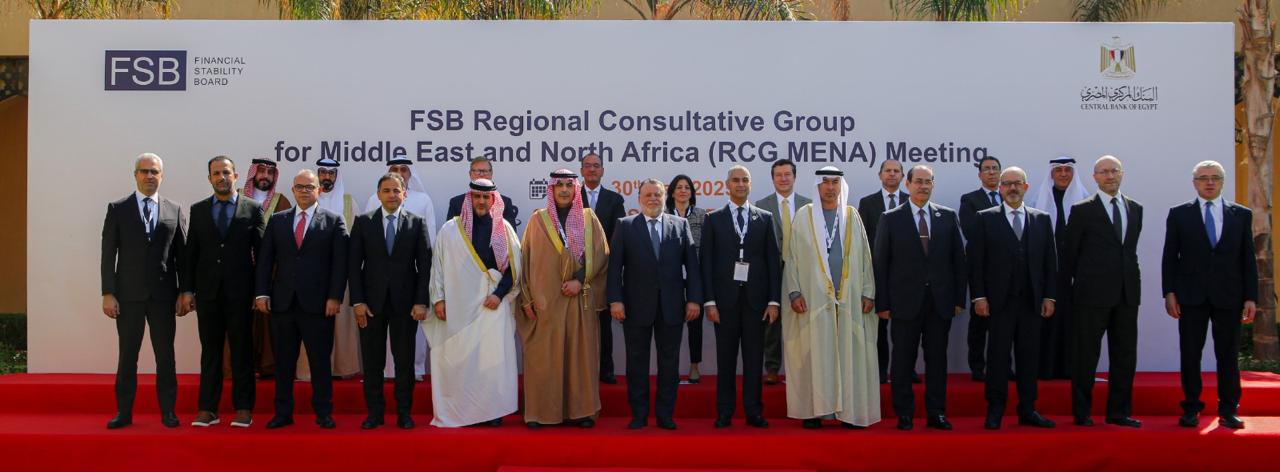
Central Bank of Egypt Hosts the Financial Stability Board Regional Consultative Group

The Central Bank of Egypt (CBE) – Co-chair of the Regional Consultative Group for the Middle East and North Africa (RCG MENA) – hosted the Financial Stability Board’s (FSB) RCG MENA Meeting.

The event was jointly chaired by H.E. Mr. Hassan Abdalla, Governor of the CBE, and H.E. Mr. Ayman Mohammed Alsayari – Governor of Saudi Central Bank (SAMA), and was held in Sharm El-Sheikh on January 29 – 30, 2025.

The event was attended by H.E. Mr. Khaled Mohamed Balama – Governor of the Central Bank of the United Arab Emirates (CBUAE) -, H.E. Mr. Bandar bin Mohammed bin Saoud Al-Thani – Qatar Central Bank Governor​ -, and H.E. Mr. Khalid Ebrahim Humaidan – Governor of Central Bank of Bahrain (CBB) -, as well as H.E. Mr. Wassim Manssouri – Acting Governor of Banque Du Liban -, along with senior officials from the member states of RCG.

In this regard, H.E. Mr. Hassan Abdalla, Governor of The Central Bank of Egypt (CBE), stated that Egypt’s hosting of the FSB meeting for the Middle East and North Africa aligns with the presidential directives to promote Egypt’s participation in international economic forums, as well as fostering integration with Arab and African countries. He also commended the vital role of the RCG’s Financial Stability Board, highlighting the key issues and topics addressed by them, which are essential for achieving financial and monetary stability, and enhancing economic collaboration among member states.

The meeting held discussions over a range of very important economic issues for RCG, the FSB’s recommendations for implementing the global framework of crypto-assets, and the progress of cross-border payment systems for member states, along with the Board’s initiatives in this regard, as well as the FSB’s work programme for 2025.

Worth mentioning, FSB is an international body that strengthens, monitors and issues recommendations regarding the global financial system to promote financial stability at the international level, in collaboration with financial authorities and international entities. The FSB encompasses 6 regional consultative groups, including RCG for MENA, which consists of 23 members from Egypt, Saudi Arabia, United Arab Emirates, Turkey, Tunisia, Qatar, Oman, Morocco, Lebanon, Kuwait, Jordan, Bahrain, and Algeria.

Central Bank of Egypt Hosts the Inaugural Meeting of the African Financial Stability Committee

,In line with the presidential directives to foster Egyptian – African cooperation and integration

,and under the auspices of H.E. Mr. Hassan Abdalla, Governor of the Central Bank of Egypt (CBE)

,the CBE hosted the inaugural meeting of the African Financial Stability Committee (AFSC)

which continued for three days, from December 9 – 11, 2024, and aimed at enhancing financial stability across the continent.

Mr. Tarek ElKholy, Deputy Governor of the CBE, launched the meetings – on behalf of the Central Bank of Egypt’s Governor – with the participation of Mr. Waesh Khodabocus, Chair of the AFSC

and representative of the Bank of Mauritius, Dr. Djoulassi Oloufade, Executive Secretary of the Association of African Central Banks (AACB),

as well as several representatives from African central banks and both the Macroprudential and African Cooperation Sectors at the CBE.

In his opening remarks, Mr. ElKholy emphasized, “The grouping of all the African countries in one committee is the seed towards endorsing a more stable and harmonized financial system, leading to a sustainable economic growth. In fact, with all the threats and challenges that the African countries have faced in recent years, it becomes crucial to enhance financial stability across the continent by coordinating the financial stability frameworks implemented in different countries. This will enable us to create Africa’s own bloc and adopt a unified voice for the Continent’s financial stability, thereby underscoring the stability of the African financial systems internationally”.

,The establishment of the AFSC marks a groundbreaking stride

.as this Committee will be the first to issue a Financial Stability Report (FSR) covering all African central banks

The report reflects the development and performance of African financial institutions through a comprehensive risk assessment framework.

,Furthermore, it will play a pivotal role in employing analytical tools, implementing macroprudential policy tools

and recommending preemptive policies against various risks. Accordingly, the Committee aims to contribute in safeguarding the stability through implementing macroprudential policies on the financial system in Africa.

Noteworthy, Mr. Abdalla proposed the establishment of the AFSC during the annual meetings of the AACB, held on September 4, 2024, in Mauritius, contributing to the maintenance of financial stability on the African level, while operationalizing a macroprudential policy.

Central Bank of Egypt Launches a New Service to Facilitate Transactions for Citizens

Central Bank of Egypt Launches a New Service to Facilitate Transactions for Citizens

Availing Inbound Remittances to Customers’ Bank Accounts Instantly

In alignment to the Central Bank of Egypt’s (CBE) continued efforts to enhance the electronic financial services’ infrastructure, promote digital transformation,

,and contribute to the transformation to a less-cash society

,the CBE provided several banks operating in Egypt with the necessary licenses and approvals

,enabling them to activate the service of instantaneous receipt of remittances

and their real-time crediting to customers’ bank accounts in Egypt, through the Instant Payment Network (IPN).

,The new feature marks a significant advancement in digital remittances

,allowing customers to transfer money from abroad to the Arab Republic of Egypt

.seamlessly and continuously to fulfill customers’ needs promptly at any time

,Noteworthy, the pilot phase of this service was launched in June 2024

.through the licensed bank correspondents and foreign exchange companies abroad

,This new feature represents a significant milestone in the evolution of the instant payment network

.which is anticipated to bolster customers’ reliance on digital financial services in their daily transactions

The CBE‘s National Instant Payment network- inaugurated in March 2022 – is one of the key component infrastructure projects,

.and stands as a cornerstone for the CBE’s payment systems infrastructure projects

,IPN’s services offer a convenient and efficient alternative to cash payments

.providing instant transfer services 24/7 to all banks’ customers

,This transition resulted in a surge in the IPN’s metrics

,with over 11.5 million users registered on the InstaPay app

.and transaction volumes are expected to surpass EGP 2.7 trillion by the end of 2024

“Central Bank of Egypt Joins the Pan-African Payment and Settlement System “PAPSS

In line with Egypt’s unwavering efforts to enhance regional banking relations and strengthen economic collaboration with African countries, the Central Bank of Egypt (CBE) approved, in November 2024, the agreement to join the Pan-African Payment and Settlement System (PAPSS).
The PAPSS – developed by the African Export-Import Bank (Afreximbank) – facilitates cross-border payments and trade transactions, reducing both costs and processing times. Notably, this is a promising step towards strengthening historical economic ties and expanding bilateral trade between Egypt and fellow African countries.
In this regard, Mr. Rami Aboulnaga, Deputy Governor of the CBE, stated that the signing of the agreement for the CBE’s participation in the new system reflects Egypt’s commitment to enhancing commercial and economic ties with countries worldwide, and with African nations in particular. He also highlighted that this development is the outcome of the continuous communication and collaboration between the CBE and African central banks.
He emphasized that the multiple benefits of PAPSS are poised to incentivize banks operating in Egypt and African banks to join the system and stimulate cross-border financial transactions with one another. The System’s membership encompasses 14 central banks from (Nigeria, Ghana, Liberia, Guinea, Gambia, Sierra Leone, Djibouti, Zimbabwe, Zambia, Kenya, Rwanda, Malawi, Tunisia, and Comoros), alongside over 50 commercial banks. Noteworthy, several banks operating in Egypt have expressed interest and willingness to join PAPSS. Under the agreement, the CBE will oversee the participation of banks operating in Egypt in the System.
This initiative is expected to substantially boost the intra-African trade, strengthen Egypt’s economic ties with African countries, and promote financial integration among African fellows. Furthermore, it will ease pressure on the demad of foreign currencies through using a net settlement mechanism across all participating countries.