رئيس مجلس الإدارة
سعيد اسماعيل
رئيس التحرير
مروة أبو زاهر

رئيس مجلس الإدارة
سعيد اسماعيل

رئيس التحرير
مروة أبو زاهر

Dell Technologies Leads AI PC Movement with New, Redesigned PC Portfolio

Dell Technologies Leads AI PC Movement with New, Redesigned PC Portfolio

 Dell AI PC portfolio boosts creativity and productivity for end users; simplifies AI for developers and IT administrators

 Unified branding across Dell’s PC portfolio makes it easier and faster to find the right PCs, accessories and services

 Latest generation silicon from Intel,® AMD and Qualcomm Technologies, Inc. offers customers enhanced performance and expanded AI capabilities

 Dell Pro AI Studio delivers industry’s most comprehensive AI PC toolkit – part of the Dell AI Factory – helping developers deploy AI applications to Dell AI PCs with simplicity and speed

Full story

Dell Technologies (NYSE: DELL) builds on decades of PC innovation with a new, simplified portfolio featuring on-device AI for greater end-user creativity and productivity.

To accelerate AI PC adoption across enterprises, Dell also provides developers and IT administrators with the tools to seamlessly build and deploy AI applications to Dell AI PCs.

As the number one provider of commercial AI PCs, Dell expands its portfolio with new product designs, increased performance and battery life, the latest silicon innovation and AI accelerators, and industry-leading capabilities across software, management and sustainability.

Dell has unified its brand across PCs, displays, services and accessories to make it even easier for customers to find the right technology solutions they need today and in the future.

“The PC is the most important personal productivity device of our lifetime and it is being transformed by AI,” said Michael Dell, chairman and CEO, Dell Technologies.

“Dell has driven PC innovation for the last 40 years and we are well positioned for this moment. Our new, streamlined portfolio of AI PCs is here to deliver the future of computing.”

Unified brand and simplified choices make technology decisions easy

Buying a PC can be a complex experience, with multiple factors to consider – brands, models, form factors, performance, graphics, storage and materials. In fact, 74% of consumers walked away from technology purchases simply because they felt overwhelmed.

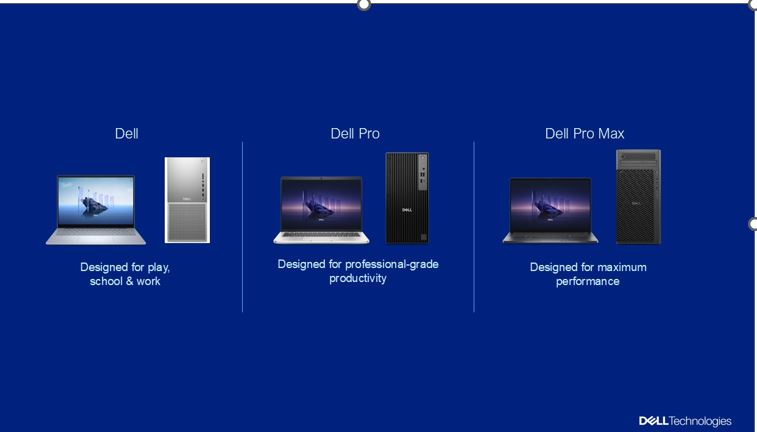
:Dell’s new branding puts the highly trusted Dell name front and center with three PC categories

.Dell: Designed for play, school and work

.Dell Pro: Designed for professional-grade productivity

.Dell Pro Max: Designed for maximum performance

.The Dell and Dell Pro product lines extend to displays, accessories and services for a consistent customer experience across the entire client portfolio

[Gamers, have no fear. Alienware continues as the leading gaming brand that’s been serving PC gamers for nearly 30 years.]

“Dell’s strategy to shift to simple, descriptive naming across its PC, ecosystem solutions and services portfolio brings significant value to customers amidst a complex and evolving AI PC landscape,” said Pat Moorhead, President, Moor Insights & Strategy. “Alongside new silicon options from AMD, in addition to Intel and Qualcomm, and new PC designs, Dell is well positioned to offer choice and help organizations futureproof for the AI era.”

Leading AI PC portfolio crafted to meet the demands of targeted use cases and workloads

Dell provides the latest silicon choices across its new portfolio while removing guesswork and complexity for end-users and businesses. New Dell AI PCs offer built-in NPU technology to deliver AI performance suited to specific workload needs.

Dell builds upon its extensive Intel® lineup by adding Intel® Core™ Ultra (Series 2) processors, expands AMD options with AMD Ryzen™ processors and continues working with Qualcomm Technologies, Inc. to offer customers the right devices for the right use-cases. The combined hardware, software and silicon innovations broaden powerful on-device Copilot+ PC experiences to reach more customers.

:With new devices across Dell, Dell Pro and Dell Pro Max, users can

.Stay productive longer with multi-day battery life

Enjoy modern and professional-grade designs wherever you work. The Dell Pro lineup is designed with durability in mind, withstanding three times as many hinge cycles, drops and bumps from regular use as competitor devices, while still featuring a sleek and stunning design. New thermal technology improves airflow by 20%, so the PC runs quietly no matter the location.

Handle intensive workloads, power demanding applications, run AI inferencing and fine tune large language models with Dell Pro Max mobile and fixed workstations packed with top performance and professional graphics. This redesigned lineup features greater performance gen-over-gen through a new, patented thermal design.

Simplify IT management and stay protected from evolving threats with the world’s most secure and manageable commercial AI PCs. IT can now manage entire fleets of Dell Pro devices—including PCs, displays and accessories—remotely. Only Dell provides this holistic device management solution, reducing operation costs and setup time, and increasing uptime.

Advance sustainability initiatives and promote PC longevity with modular designs and increased use of recycled, renewable and low-emissions materials throughout the portfolio. Dell Pro and select Dell Pro Max are the world’s first commercial notebooks built with a modular USB-C port. Initial tests show that the port is up to four times more durable and enables easier repairs.

Enjoy best-in-screen performance with new displays, including the world’s first monitor with enhanced IPS Black featuring 3000:1 contrast ratio and the highest five-star TUV eye comfort certification. Plus, with a world’s first QD-OLED monitor with AI-enhanced 3D Spatial Sound, these new displays build on Dell’s decade of display leadership.

Dell accelerates AI PC adoption with Dell Pro AI Studio

Businesses want to use AI models trained on their data to address specific needs and run them locally on AI PCs for better efficiency. However, building and managing these models is challenging because hardware requirements differ across silicon vendors and CPUs, GPUs, and NPUs.

Dell is making AI development on PCs easy with the Dell Pro AI Studio, the industry’s most comprehensive AI toolkit leveraging NPU technology. With Dell validated tools, frameworks, templates and models, developers and IT administrators can build and manage AI software with simplicity and speed, regardless of the underlying silicon.

.This is expected to reduce development and deployment time by as much as 75%, going from six months to as little as six weeks

Dell Pro AI Studio, part of the Dell AI Factory, is another example of how Dell helps enterprises right-size, implement and scale AI across various environments – from PCs to data centers. The Dell AI Factory gives customers access to the industry’s broadest AI portfolio and an open ecosystem of technology partners to create AI applications that meet their unique needs, budgets and power requirements.

?Mohammed Amin…Transformative Tech in 2025: Is the Test and Learn Phase Starting to Pay Off

?Transformative Tech in 2025: Is the Test and Learn Phase Starting to Pay Off

Mohammed Amin, Senior Vice President, CEEMETA, Dell Technologies

,No longer a mere buzzword, Artificial Intelligence (AI) has emerged as the cornerstone of the region’s transformative journey. In 2024

.businesses explored and experimented with GenAI tools, positioning AI as a central driver of operations

.The following 12 months promise an era of accelerated digital transformation fuelled by cutting-edge technologies

.From AI-powered PCs to next-generation data center innovations, here’s how business leaders can stay ahead of what’s coming

AI to Deliver Real Business Value

2025 is set to be the year AI shifts from exploration to execution. According to McKinsey, GenAI usage has doubled in just 10 months, where businesses in these stages are learning, testing and gaining insights into what AI can achieve.

For many, the test and learn phase is starting to pay off. Over the next year, enterprises will continue to see real ROI as they scale AI. A Strategy& report estimates that GenAI could contribute up to $23.5 billion annually to the Middle East’s economy by 2030.

,Media and entertainment are projected to lead this impact with $8.5 billion, followed by healthcare at $3.8 billion, banking and financial services at $3.5 billion

and IT and telecommunications at $2.9 billion. For the region’s media, healthcare and finance industries, the time has come to move from pilot projects to scaled solutions.

.The focus should shift to developing tailored, scalable AI applications that solve current challenges while also positioning companies for future opportunities

What this means: If your AI strategy isn’t clearly defined yet, make it your top priority in 2025. Tools are maturing at an incredible pace, and businesses that fail to adapt risk falling behind.

Introducing AI PCs: The Future of Work in Your Hands

Imagine starting your day with a PC that’s already handled the basics – drafted follow-ups, organized your to-do list, or summarized your emails while you were still making coffee. Welcome to 2025, where AI PCs bring this level of convenience to life.
These PCs are set to revolutionize how work gets done. Equipped with embedded AI capabilities, they can process data locally, resulting in faster performance, enhanced security and cost efficiency.

This is particularly beneficial for regional businesses balancing distributed teams and hybrid work environments. The importance of the edge – where data is created and consumed – is also growing. AI PCs are redefining productivity by shifting work closer to where it happens. Between higher performing CPUs, GPUs and NPUs and more PC silicon options in the market than ever before, the choice and innovation will be the best it’s ever been.
What this means: For industries evolving at breakneck speed, having smarter devices is no longer optional – it’s essential. If you’re holding onto older hardware, now may be the time to make the leap.

Rethinking the Data Center for an AI-driven World

AI is advancing faster than any technology in recent memory. In a recent analyst discussion, we found that by 2025, the overwhelming majority of AI processing (up to 70-90 percent) will focus on inferencing – using AI to make real-time decisions. This shift isn’t just an upgrade; it’s a demand for entirely new approaches to data infrastructure.

It’s why traditional siloed data centers are being replaced by “disaggregated architectures,” which allow computing, storage, and networking systems to scale independently. This provides businesses with faster, more flexible operations without being locked into specific vendor solutions, a crucial step forward for companies aiming for efficiency and agility.

Furthermore, the rising cost of energy and the environmental impact of AI workloads on regional data centers present additional challenges. To meet this demand, businesses must adopt energy-efficient hardware and diversified energy sources.
Liquid cooling innovation is a perfect example. In our liquid-cooled compute solutions, you’ll see optimized cold plates and leak detection technology for unmatched reliability and efficiency.

Additionally, workload management and monitoring tools are essential for optimizing performance, reducing costs, and ensuring AI solutions meet specific organizational needs.
What this means: Reassess your data center strategies now to ensure they can support the scalability, flexibility, and energy efficiency required by AI-driven workloads.

Evolving with AI Agents

2025 will also mark the rise of AI agents, which go far beyond chatbots or virtual assistants. AI agents are software systems that can plan,

.make decisions and take action to achieve pre-defined goals. They will be everywhere next year and will have a big impact on how we use AI

Unlike reactive systems of the past, AI agents are evolving into proactive tools capable of managing complex workflows. From resolving intricate customer service queries to tailoring real-time marketing campaigns, AI agents will enable businesses to push boundaries.

Gartner forecasts that by 2028, one-third of generative AI interactions will be handled by these agents.

What this means: Instead of managing people alone, professionals across industries will increasingly manage AI agents. It’s a move toward more dynamic, personalized, and creative work environments.

AI Becomes a Universal Skill

.Recent surveys reveal that 72% of IT leaders identify AI skills as a critical gap requiring immediate attention

,AI will become a cornerstone of every business, further refining collaboration between humans and machines. Routine, task-oriented roles may diminish

.and new opportunities, such as software composers, AI content editors and prompt engineers will gain prominence

.It will empower leaders to explore new roles, innovate, and lead in a competitive business landscape

What this means: Companies must prioritize upskilling their employees to build AI proficiency. Businesses equipped with AI can redefine how tasks are completed, unlocking new growth frontiers.

A Checklist for Business Leaders in 2025

Commit to AI: Develop a comprehensive AI strategy. Test new applications, learn from initial challenges, and scale successful solutions quickly.
Upgrade Your Tech Stack: From AI-powered PCs to modernized data centers, ensure your infrastructure aligns with your ambitions.
Lead on Sustainability: Adopt energy-efficient technologies to position your brand as an environmentally responsible leader.
Equip Your Teams: Empower employees with tools like AI agents that free them from repetitive tasks and unlock their strategic potential.
The businesses that thrive in 2025 will be those that approach these changes with clarity, agility and purpose. For the region’s vibrant tech ecosystem, the year ahead promises transformational growth. Are you ready to lead the way?

Dell Technologies Expands AI Innovations at the Edge

Dell Technologies Expands AI Innovations at the Edge
Dell NativeEdge software provides secure, high-availability clustering capability for NativeEdge Endpoints to boost edge workload resiliency


Dell Technologies

From retail stores to factory floors, Dell NativeEdge AI innovations simplify operations and automate AI deployments

at scale across a diverse range of edge environments
Dell Technologies announces advancements to its Dell NativeEdge edge operations software platform to simplify how organizations can deploy, scale and use AI at the edge.

Why it matters:
According to Gartner®, “by 2025, more than 50% of enterprise-managed data will be created and processed outside the data center or cloud.”1 As organizations increasingly move data toward the edge and AI accelerates new edge workloads, the demand is rising for agile, connected and secure systems to deploy and manage AI models across multiple edge locations.


Today’s Dell NativeEdge advancements, part of our Dell AI Factory capabilities, address these needs and offer organizations AI software integrations and high-availability (HA) capabilities to provide more resiliency and reliability in the deployment and management of AI at the edge.

Boost Edge and AI Workload Efficiency with NativeEdge
Dell NativeEdge is the industry’s only edge operations software platform delivering secure device onboarding at scale, remote management and multicloud application orchestration2. NativeEdge software now enables multinode high-availability (HA) clustering for NativeEdge Endpoints, such as Dell PowerEdge servers, OptiPlex and Precision workstations and Dell Gateways.

The endpoints can be clustered, or grouped together by NativeEdge software to act like a single system, so organizations can:
Provide high-availability capabilities to maintain critical business processes and edge AI workloads, despite network disruptions or device failures. Virtual machine (VM) migration and automatic application, compute and storage failover provide organizations increased reliability and continuous operations.

Easily adapt to changing workload demands across diverse environments, from retail stores to utility companies.
Integrate NativeEdge Endpoints with external storage solutions, such as Dell PowerStore and Dell PowerVault, to support the training and deployment of AI models with the versatility of single, two-tier or three-tier solutions at the edge.

NativeEdge AI Software Integrations Simplify Edge AI Deployments
Organizations implementing AI inferencing at the edge may find it tedious and time consuming to deploy AI applications and solutions across hundreds, if not thousands, of edge locations. Dell offers a comprehensive catalog of more than 55 pre-built Dell NativeEdge Blueprints that automate the deployment of an organization’s choice of AI applications and frameworks for faster time to value. The NativeEdge Blueprints provide customers an easy button to assemble and deploy new use cases and AI inferencing capabilities at the edge, while reducing manual set up time and errors.
Dell is expanding the catalog to include:


Open-source tools, such as Apache Spark™, Apache Airflow®, MLflow, and Grafana, to support continuous MLOps workflows tailored for edge use cases, for quick and efficient deployment of AI-enhanced solutions.
Aveva Unified Operations Center, to facilitate city infrastructure modernization in integrated operations, building systems, master planning, intelligent urban mobility and critical connectivity.
EPIC iO, which uses real-time analytics for retail operations to enhance the in-store shopper experience.

Dell Data Collector, to collect and transfer data from sensors and IoT devices to various locations in near real-time with. Organizations can use Dell Data Lakehouse to query the data for real-time insights and AI workloads.


The Intel® Geti™ software solution, to accelerate the development of computer vision AI models at the edge.
Updates to the NVIDIA AI Enterprise software platform, which includes NVIDIA NIM microservices, enable developers to more efficiently and securely deploy AI inferencing capabilities at the edge, while reducing manual setup time and minimizing errors.

Dell Services for NativeEdge Blueprints help organizations design and develop custom NativeEdge Blueprints for Dell validated and customer-owned applications, providing seamless deployment using Dell NativeEdge software.

Perspectives
“AI is accelerating new edge workloads and opportunities at an unprecedented rate, and organizations across industries are asking for simpler and more reliable ways to use AI at the edge,” said Gil Shneorson, senior vice president, solutions and platforms, Dell Technologies. “Our NativeEdge expansion automates the deployment and management of edge AI workloads, with features to support business continuity, so organizations can continually use the latest AI advancements at the edge to drive revenues and positive customer outcomes.”

“With over 1,000 IoT-enabled facilities, Dell NativeEdge helps us monitor real-time infrastructure elements, ensuring optimal conditions for our produce, and receive comprehensive insights into our produce packaging operations,” said Keith Bradley, vice president, Information Technology, Nature Fresh Farms. “Dell NativeEdge has enhanced our operational efficiencies and reduced costs, while supporting our continued growth and innovation in yield optimization and environmental monitoring.”

1Gartner, Hyperscalers Stretching to the Digital Edge, Tom Bittman, July 24, 2023. GARTNER is a registered trademark and service mark of Gartner, Inc. and/or its affiliates in the U.S. and internationally and is used herein with permission. All rights reserved.

2 Dell Technologies internal analysis, May 2024.

“Apache” is a registered trademark or trademark of the Apache Software Foundation in the United States and/or other countries.

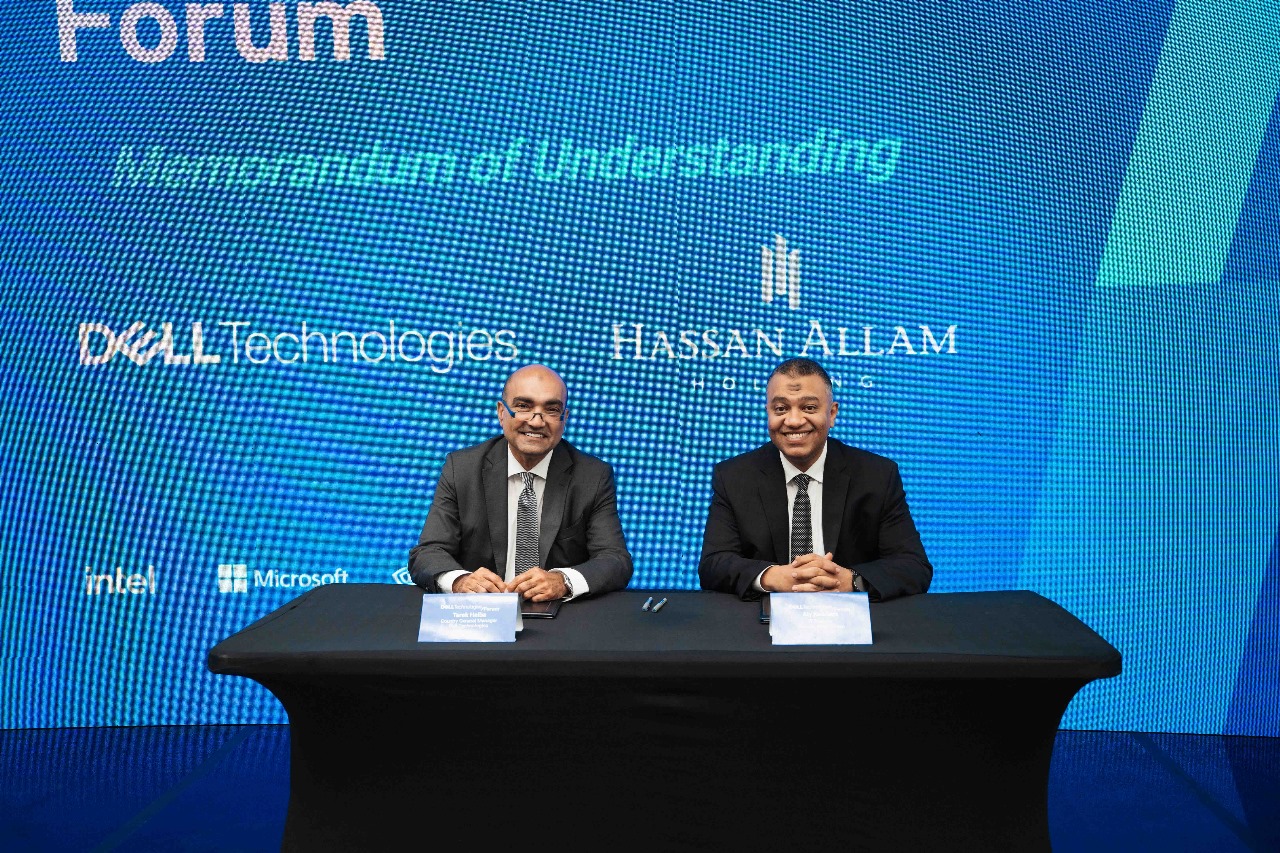
Dell Technologies and Hassan Allam Holding Sign Memorandum of Understanding to Enhance Technological Capabilities in Egypt

Dell Technologies signed a Memorandum of Understanding (MOU) with Hassan Allam Holding at Dell Technologies Forum in Cairo on October 8th. Through this agreement, Dell will provide services and solutions across servers and storage and potentially extend the collaboration to include client, backup, and recovery solutions.
The MoU was signed by Tarek Heiba, Managing Director, Egypt at Dell Technologies and Aly Kouriem, Group IT Director, Hassan Allam Holding to fuel growth and enhance efficiency across various operations.