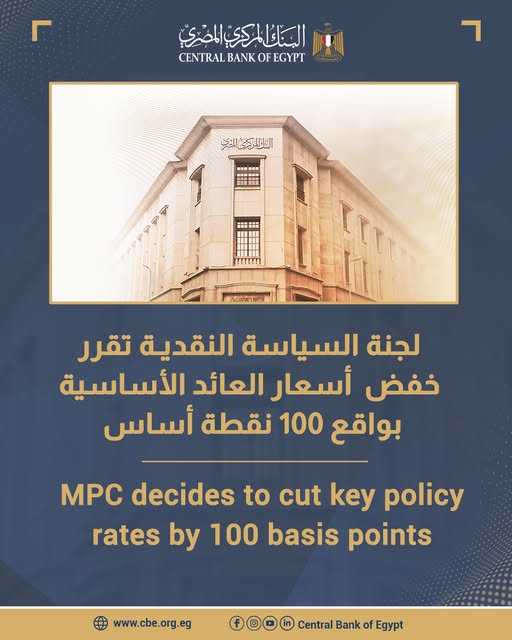
The Monetary Policy Committee (MPC) of the Central Bank of Egypt (CBE)
today decided to cut key policy rates by 100 basis points. Accordingly, the overnight deposit
rate, overnight lending rate, and the rate of the main operation were reduced to 19.0 percent,
20.0 percent, and 19.5 percent, respectively. The discount rate was also cut to 19.5 percent.
The Monetary Policy
In addition, the CBE Board of Directors reduced the required reserve ratio (RRR) for
commercial banks from 18 percent to 16 percent. These decisions reflect the Committee’s
assessment of current inflation dynamics and the evolving outlook since the previous MPC
meeting.
Globally, economic growth continued to be resilient supported by relatively accommodative
financial conditions. However, this momentum continues to be dampened by geopolitical tensions,
trade policy uncertainty, and moderating demand in major economies. While inflation has been
broadly contained across advanced and emerging market economies, central banks have mostly
maintained a cautious approach to monetary easing.
Within commodity markets, ample global
supply has cushioned oil prices against shocks, while agricultural prices have shown varying
trends. Nonetheless, the global outlook remains subject to uncertainty, particularly from possible
supply-chain disruptions, adverse shifts in trade policies, and potential escalation of geopolitical
tensions.
Domestically, the updated CBE nowcast for Q4 2025 points to a marginal moderation in growth,
with real GDP growth expected to register around 4.9 percent, compared to 5.3 percent in the
previous quarter. Growth in Q4 2025 was driven by positive contributions from non-petroleum
manufacturing, tourism, and communications.
Furthermore, the CBE forecasts real GDP growth
to average 5.1 percent in FY 2025/26, up from 4.4 percent in the previous year. Nevertheless,
output remains below—but gradually approaching—potential capacity, with the current output
trajectory continuing to support the forecasted disinflation path in the short term. This indicates
that demand-side inflationary pressures are expected to remain contained under the current
monetary stance.
With respect to inflation, annual headline and core readings declined to 11.9 percent and 11.2
percent in January 2026, from 12.3 and 11.8 percent in December 2025, respectively, continuing
the downward trajectory observed throughout 2025. In particular, headline and core inflation
averaged 14.1 and 12.1 percent in 2025, down from 28.3 and 27.2 percent in 2024, respectively.
This deceleration was driven by food inflation reaching its lowest levels in four years, alongside a
slower deceleration in non-food inflation. The latter benefitted from recent exchange rate
appreciation, subdued demand due to the tight monetary stance, and favorable inflation
expectations.
While monthly dynamics are normalizing to pre-shock levels, January 2026 saw a
typical seasonal uptick ahead of Ramadan. However, this uptick was partially mitigated by mild
declines in non-food inflation, especially services. Overall, the recent broad-based easing in
monthly price dynamics and the declining frequency and magnitude of fiscal measures point to an
improving outlook.
Reflecting recent inflation outturns, CBE forecasts point to annual headline inflation remaining
largely stable near current levels in Q1 2026, and is expected to resume its broadly declining path
during the remainder of the year. As such, inflation is on track to reach the CBE target of 7 percent
(± 2 p.p.), on average, in Q4 2026, supported by a broad-based easing of inflationary pressures,
gradual dissipation of earlier shocks, contained demand-side pressures, and a strengthening of the
external position. However, the disinflation path remains constrained by relatively persistent non
food inflation and susceptible to upside risks, including a higher-than-expected pass-through from
fiscal consolidation measures to inflation, and a possible re-escalation of global and regional
geopolitical tensions.
In view of the above, the MPC judges that a 100-basis-point cut in key policy rates, complemented
with a two-percentage point reduction in the RRR, is consistent with upholding a monetary policy
stance conducive to achieving the inflation target. The reduction in the RRR aims to safeguard the
effectiveness of monetary policy transmission through ensuring effective pass-through of CBE
decisions to money markets and the broader economy by appropriately calibrating liquidity
conditions within the banking system.
Looking ahead, the Committee will determine the
magnitude and pace of monetary easing based on evolving economic conditions, with policy
decisions remaining contingent on the forecasted inflation trajectory, incoming data, and the
balance of risks. The Committee will continue to remain vigilant and stands prepared to adjust its
policy instruments as needed to fulfil its price-stability mandate, steering inflation toward the CBE
target of 7 percent (± 2 p.p.) in Q4 2026, on average.